I have a confession.
Earlier this year, I became a little concerned that I might be out of a job in 12 to 18 months.
Not because of a bad performance review or some ordinary workplace problem.
Because of AI.
In February 2026, Mustafa Suleyman, CEO of Microsoft AI, made a fairly aggressive prediction about the future of professional work. He said AI was approaching human-level performance across professional tasks and specifically mentioned lawyers, accountants, marketing professionals—and project managers.
His prediction included this line:
“Most of those tasks will be fully automated by an AI within the next 12 to 18 months.”
That got my attention.
I am, after all, a project manager.
My reaction was something along the lines of:
Oh my God. I'm going to be out of a job in 12 to 18 months.
There was also something slightly ironic about worrying that AI might eliminate my profession while simultaneously spending a great deal of my free time experimenting with AI.
So I kept experimenting.
And over the last several months, my thinking has changed.
I don't think the biggest question is whether AI is going to replace project managers.
I think the more interesting question is what happens when AI becomes capable of doing a large percentage of the work project managers—and many other professionals—currently do manually.
Can I just tell Copilot what I want?
Consider a fairly ordinary business problem.
Suppose an organization needs a purchase requisition system.
I'd like to eventually be able to tell Microsoft Copilot:
“Build me a purchase requisition system.”
I describe what the organization needs. I give it the requirements and constraints.
Then I pop open a can of Diet Mountain Dew and let AI take it from there.
- It builds the application.
- It creates the workflows.
- It develops the data structure.
- It produces the documentation.
- It creates the project plan.
- It tests everything.
- Maybe it even politely reminds everyone about their overdue action items.
I come back later and inspect the finished product.
We're not there yet.
But we're getting closer.
Microsoft is actually building toward this
Microsoft's current Power Apps tools already allow people to describe business requirements in natural language and use AI to help create applications.
More significantly, Plans in Power Apps allows someone to describe a business problem in natural language and generate a proposed Power Platform solution. Microsoft says that solution can include Dataverse tables, canvas apps, model-driven apps, Power Pages, Power Automate flows, and Copilot Studio agents.
Microsoft is also developing an AI-native experience called Power Apps vibe. In the current preview, a user can describe an application, review a proposed plan, let AI generate an app and data model, inspect the resulting code, and continue refining the application conversationally.
That last part needs an important qualification: Microsoft currently labels Power Apps vibe as a preview, and Microsoft specifically warns that preview features are not intended for production use.
Still, look at the direction.
We are moving toward something that increasingly resembles:
Describe the business problem → AI proposes the solution → AI builds version one → human reviews and improves it.
That's a major change.
But the more I experiment with these tools, the more convinced I become that generating the application isn't necessarily the hardest part.
Building the screen is easy
Go back to our purchase requisition system.
Creating a field called Vendor isn't particularly difficult.
Neither is creating a field called Amount.
An AI can generate an approval button.
It can create a form.
It can build a workflow.
The difficult questions start afterward.
- Who is allowed to submit the request?
- Who approves it?
- What happens when someone's supervisor doesn't have enough spending authority?
- Does the approval process change depending on the dollar amount?
- Which purchases require additional review?
- When should Legal become involved?
- What happens when the purchase amount changes after someone has already approved it?
- How do you preserve exactly what the approver reviewed when the approval occurred?
- What information becomes an official record?
- How long does that record need to be retained?
- Who is allowed to see another employee's requisition?
- What happens when an automated workflow fails halfway through?
- What happens when an approver leaves the organization?
And one of my favorite questions:
Who owns this thing three years from now?
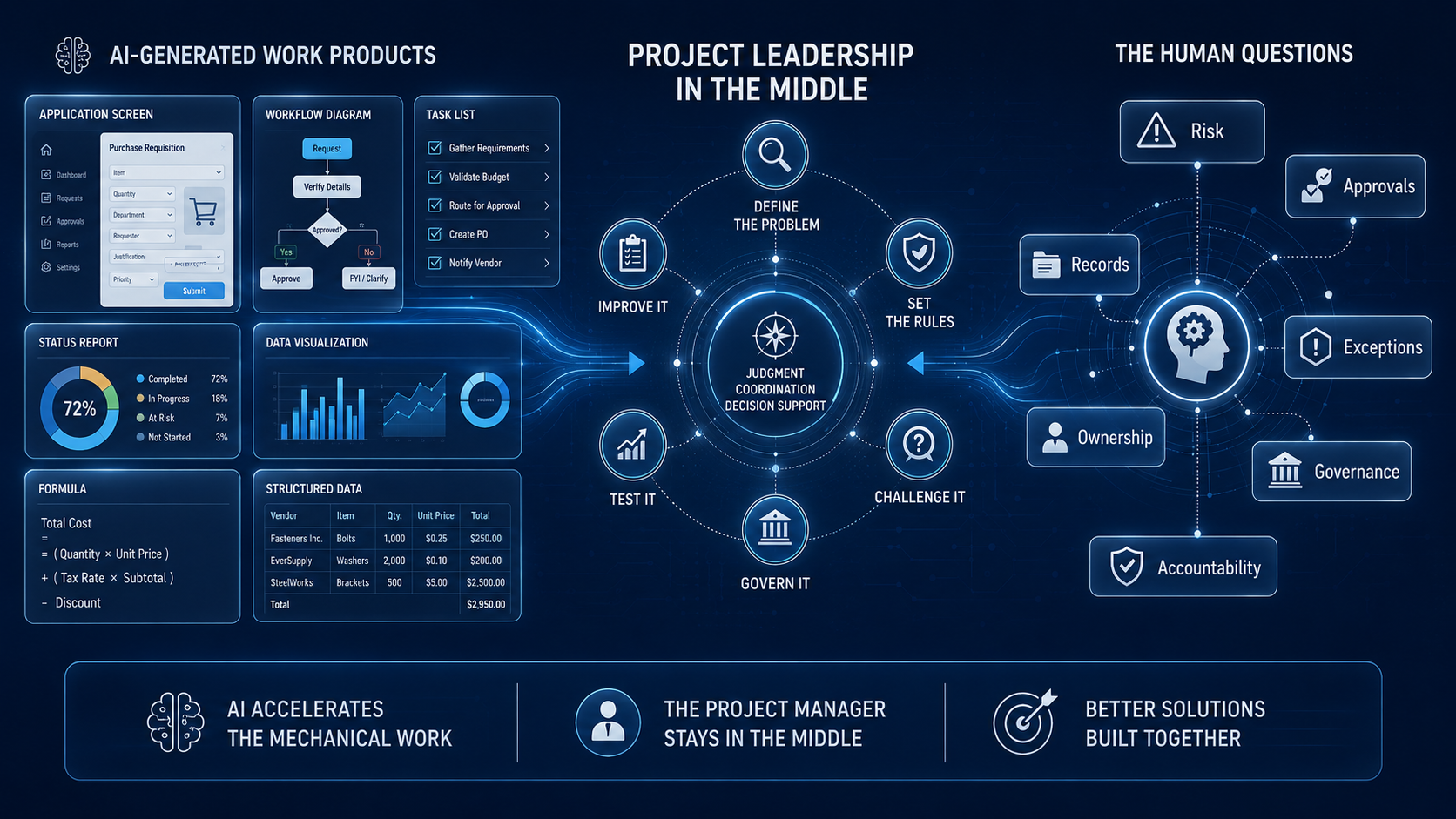
AI may become extraordinarily good at writing the formulas, creating the tables, generating the interfaces, building the workflows, and documenting the system.
But somebody still has to determine what the rules actually are.
Someone has to discover that two departments have different interpretations of those rules.
Someone has to recognize the exception nobody mentioned during the requirements meeting.
Someone has to decide which risks are acceptable.
Someone has to challenge assumptions.
And ultimately, someone has to be accountable for whether the resulting system is correct.
That's the part I find increasingly interesting.
There was an important clarification
There is another part of Suleyman's prediction worth mentioning.
In June, a few months after his original comments, The Verge's Nilay Patel challenged him about the implications of that 12-to-18-month prediction.
If AI can automate most of the work performed by lawyers, accountants, project managers, and other professionals, wouldn't that mean those people lose their jobs?
Suleyman made an important distinction:
Tasks are not the same thing as jobs.
He explained that activities such as preparing presentations, sending emails, communicating with colleagues, and other components of professional work can increasingly be automated without necessarily eliminating the entire role.
That clarification is important because it is very close to the conclusion I've reached from actually working with AI.
AI doesn't have to replace the project manager to radically change project management.
It just has to start eliminating more and more of the mechanics.
- Drafting documents.
- Summarizing meetings.
- Producing status reports.
- Creating first-pass requirements.
- Researching alternatives.
- Writing formulas.
- Building workflows.
- Generating application screens.
- Analyzing data.
- Tracking actions.
- Creating first drafts of project plans.
I already use AI for several of those things.
The result isn't that I suddenly have nothing left to do.
Usually the opposite happens.
I have more time to think about whether what we're doing makes sense.
The value moves somewhere else
If AI keeps making the mechanical parts of professional work cheaper and faster, then the human value moves.
The questions become:
- What problem are we actually trying to solve?
- What outcome matters?
- Which requirements are real requirements and which are assumptions nobody has challenged?
- Where is the organizational risk?
- Who owns the decision?
- What should we automate, and what should remain human?
- What happens when the automated process encounters something nobody anticipated?
- When is a solution trustworthy enough to use?
- Who is accountable when it isn't?
That starts looking different from traditional task-oriented project management.
It looks more like a combination of project leadership, business analysis, process improvement, solution design, risk management, governance, and organizational decision support.
And I suspect that may be one of the bigger AI disruptions for project management.
The future may not be AI replacing the project manager.
It may be AI eliminating enough of the project manager's traditional workload that organizations begin expecting project managers to operate at a much higher level.
For the record, I'm still employed
It has been roughly six and a half months since Suleyman made his prediction.
I have not been automated out of a job.
But I can't declare victory, either.
His prediction was 12 to 18 months. We're only about halfway through the shorter end of that window.
More importantly, there is an enormous difference between showing that AI can perform a task and trusting AI to perform that task inside an actual organization.
A demonstration can be impressive.
A real organizational system has security requirements, records requirements, exceptions, conflicting stakeholders, permissions, maintenance, governance, accountability, and consequences when something goes wrong.
That gap matters.
My own prediction—and I want to be clear that this is my prediction, not an established fact—is that building many routine business applications will increasingly become something like:
Define the problem → define the rules → let AI build version one → test it → challenge it → govern it → improve it.
If I'm right, knowing how to manually build every screen, formula, workflow, project document, and status report becomes less valuable by itself.
Knowing what should be built, why it should be built, what could go wrong, and whether the result can be trusted becomes more valuable.
So I've stopped spending as much time worrying about this question:
“Will AI take my job?”
I'm more interested in another one:
“What parts of my job should I stop doing manually so I can spend more time on the work AI still cannot responsibly own?”
I don't know exactly where all of this ends.
Nobody does.
But for now, there is still plenty of work left for me.
And apparently I still have to open my own Diet Mountain Dew.
These are my personal views and do not represent my employer or any organization with which I am affiliated.
Sources and further reading
Factual claims are linked to the sources reviewed for this note. Interpretations and predictions are my own.
- Financial TimesMustafa Suleyman plots AI ‘self-sufficiency’ as Microsoft loosens OpenAI ties ↗
- The Verge / DecoderMicrosoft's AI chief says superintelligence is near, but won't take your job ↗
- Microsoft LearnOverview of plans ↗
- Microsoft LearnCreate apps, data, and plans together using vibe (preview) ↗
- Microsoft LearnOverview of the new Power Apps vibe experience (preview) ↗