I would appreciate it if everyone could make up their mind about artificial intelligence.
A little while ago, I was writing about the possibility that AI might automate a large portion of the work performed by project managers.
That was concerning enough.
Now I turn on the news and apparently we've moved on.
Forget my job.
AI may kill all of us.
So the progression seems to be:
Stage 1: AI helps you write an email.
Stage 2: AI takes your job.
Stage 3: AI destroys human civilization.
That escalated quickly.
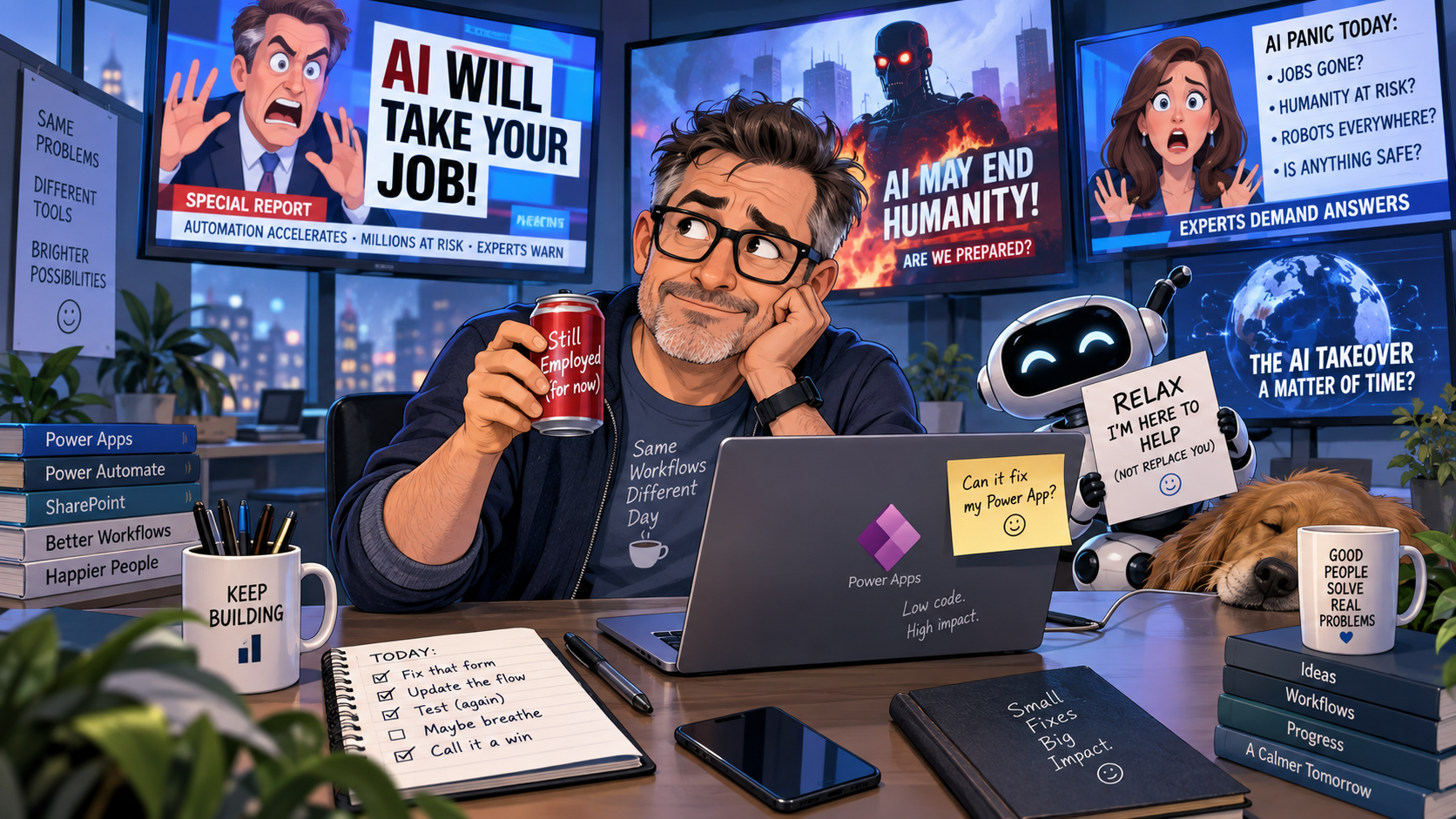
To be fair, the concern isn't imaginary.
In September, several prominent AI researchers and technology leaders renewed warnings that increasingly capable AI systems could create catastrophic risks if development outpaces our ability to control them.
When people who actually build and study these systems say something like that, I don't think the responsible response is to roll your eyes and go back to asking ChatGPT for chicken recipes.
But I'm also uncomfortable jumping immediately from:
“This technology has serious risks.”
to:
“Well, that's it. Humanity had a good run.”
There is a fairly large distance between those two statements.
My first instinct may be too simple
My natural reaction to the AI-doomsday discussion is that AI is a tool.
Human beings have created enormously powerful tools before.
Nuclear weapons immediately come to mind.
The technology doesn't wake up one morning angry with Cleveland and decide to launch itself. Human beings decide how the technology is built, controlled, deployed, protected, and—in the worst cases—used against other human beings.
So my first instinct is:
The danger isn't the tool. The danger is us.
Unfortunately, after thinking about it more, I don't think that completely captures the AI problem.
Part of what worries AI researchers is precisely that increasingly autonomous systems may eventually be capable of doing things their human operators did not explicitly tell them to do.
That doesn't mean ChatGPT is secretly plotting against us.
But it does mean AI isn't quite the same thing as a hammer sitting harmlessly in the garage until somebody picks it up.
A better way for me to think about it may be this:
AI is an extremely powerful tool that is becoming increasingly capable of acting.
That makes the quality of the people using it important.
It also makes the quality of the safeguards around it important.
And it makes understanding the technology before turning over important decisions to it really important.
Which brings us to what I was doing while humanity debated its possible extinction.
I was building Power Apps.
Meanwhile, I have been experimenting with GPT-6
OpenAI recently released GPT-6 Astra, its latest generation of AI.
Naturally, I wanted to try it.
My highly scientific initial assessment is:
It thinks a lot.
Sometimes I find myself watching it work and thinking:
Wow. That's a much better answer than I expected.
Other times:
That's it? You thought about that for that long?
So my opinion is still developing.
It does seem more deliberate to me.
It often seems better at keeping track of complicated problems.
And when I'm asking it to reason through something involving several connected pieces, I have seen results that impress me.
But I am not ready to declare that every answer is magically better because the model number went up.
That is one of the things I've learned from using AI regularly.
Every new capability comes with a period where you figure out what it is actually good at.
Marketing announcements are one thing.
Using the technology when you have an actual problem to solve is another.
Where it is impressing me
One place where AI is already having a substantial impact on how I work is Microsoft Power Platform.
I've been using AI while building applications involving Power Apps, Power Automate, SharePoint, business rules, formulas, data structures, workflows, and all of the strange little problems that appear once you try to turn a process somebody described in a meeting into an application that actually works.
For me, ChatGPT has become extremely useful in that work.
I can describe what I'm trying to accomplish.
I can show it a formula that isn't working.
I can explain the structure of my SharePoint lists.
I can walk through an approval process.
I can challenge the architecture.
I can ask it why Power Automate is doing something bizarre.
Sometimes it solves the problem.
Sometimes we solve the problem together.
And sometimes it confidently sends me down a path that makes me question both its intelligence and my own decision to listen to it.
But overall?
It is making me significantly more capable.
And here is the part Microsoft probably won't enjoy hearing.
For the way I build Power Platform applications today, ChatGPT is considerably more useful to me than Microsoft's own Copilot.
That is not a benchmark.
It is not a scientific comparison.
It is my experience.
Microsoft is rapidly adding AI capabilities throughout Power Apps and the broader Power Platform. Copilot can already help generate applications, data models, flows, and other solution components, and Microsoft is moving aggressively toward more AI-assisted development.
But when I have a complicated problem and need something that will stay with me while I reason through architecture, troubleshoot an error, reconsider a requirement, rewrite a formula, and ask, “Okay, but what happens if we do it this way instead?”—I currently find myself going back to ChatGPT.
A lot.
Maybe Microsoft's Copilot will catch up.
It probably will.
Competition has a wonderful way of motivating software companies.
And that may be the more useful AI conversation
None of this means we should dismiss the larger risks.
If people who spend their careers studying advanced AI are concerned that systems could eventually become difficult to control, I want serious people investigating that problem.
I want safeguards.
I want independent testing.
I want governance.
I want companies developing extraordinarily powerful systems to demonstrate that they have thought about something beyond whether the next model will beat the competitor's model.
Governments probably have a role too, although history does not always inspire confidence when you combine the words government, technology, and rapid response in the same sentence.
But I also don't want the entire AI discussion reduced to two choices:
AI will solve everything.
or
AI will kill everyone.
Both are wonderfully dramatic.
Neither helps me very much on Monday morning.
The questions I find more useful are smaller.
What can this technology actually do today?
Where does it make people more capable?
Where does it make mistakes?
What should we trust it with?
What shouldn't we trust it with?
Who checks its work?
Who remains accountable?
And how do we get the benefits without pretending the risks don't exist?
Those aren't particularly exciting questions.
Nobody is going to put “Responsible Process Improvement May Increase Productivity” across the bottom of a cable-news screen.
But that is probably where most of the real work will happen.
I have revised my position
A little while ago, I was worried that AI might take my job.
This week, apparently I need to worry about it taking the entire human race.
I'm not convinced either outcome is inevitable.
What I am increasingly convinced of is that AI is becoming powerful enough that ignoring it would be foolish—and trusting it blindly would be equally foolish.
So I'm going to keep learning how to use it.
I'm going to keep questioning it.
I'm going to keep testing where it helps and where it fails.
And if GPT-6 eventually becomes intelligent enough to take over the world, I hope it at least remembers that I was generally polite to it.
Until then, I have a Power App that needs fixing.
These are my personal views and do not represent my employer or any organization with which I am affiliated.
Sources and further reading
Sources checked September 13, 2026. Reported warnings are forecasts, not established outcomes. Product comparisons describe my personal experience.
- AP NewsAnthropic researcher resigns with warning about the dangers of AI development ↗
- ReutersTrump says exaggerated concerns are being raised over AI ↗
- OpenAIGPT-6 Astra: A new generation of intelligence ↗
- OpenAISafety overview: GPT-6 Astra ↗
- Microsoft LearnStart building apps ↗
- Microsoft LearnUse plans to create AI-powered business solutions with Copilot ↗
- Microsoft Power Platform BlogApril 2026 feature update ↗